Farm and plank fences for acreage, horses and long Kentucky runs
Out past the Gene Snyder, where lots open into pasture and paddock, fencing stops being about privacy and starts being about miles of line, livestock and rolling ground. A board fence along a gravel drive, a woven wire pasture for goats, or a high-tensile perimeter around a hayfield each asks for different materials, different bracing and different upkeep. This page covers the farm and plank side of the trade for owners of acreage in outer Jefferson County, Oldham County and the edges of Bullitt County: four-board plank and how to paint it, oak against treated pine, post-and-rail, wire fence types, horse-safe choices, corner bracing, equipment gates, rock and sinkholes, and the maintenance that keeps a long fence standing.
The four-board fence and why it reads as Kentucky
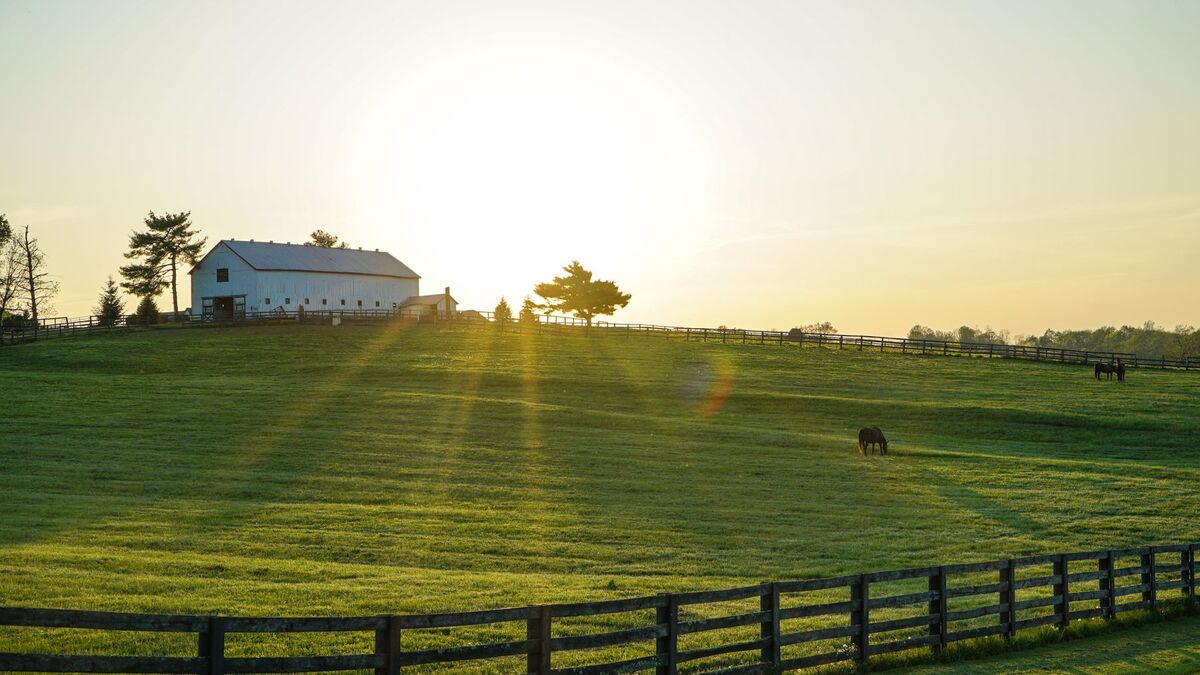
Few things say Bluegrass horse country like a long run of black or white four-board fence following the curve of a hill: heavy posts at regular spacing, four horizontal planks, the joints lapped so they fall on different posts as you move up the fence. It reads clearly to a horse, takes a lean, and leaves the land visible.
Around the Louisville area it turns up on horse farms in Oldham County, on hobby acreage near Prospect, Crestwood and La Grange, along rural frontage in outer Jefferson County, and on large suburban lots where owners want the country look without a single animal. The Prospect page describes how bigger lots and river bluffs shape a fence job there.
Oak boards or treated pine: the material choice
Rough-sawn oak is the traditional plank. It is dense, holds nails well and drinks in black fence coatings through its rough face. Green oak also shrinks, checks and cups as it dries on the fence, so owners who choose it accept a season of settling and a few boards to re-nail. Pressure-treated pine is lighter, straighter and more uniform, resists rot and insects, and holds paint differently because of its smooth face. Posts in either case are normally treated pine rated for ground contact.
- Boards are commonly cut to span two bays, so post layout and lumber order have to agree.
- Stagger joints so no single post carries every board end on one side.
- Nail boards to the animal side of the posts, so a pushing horse presses them in rather than off.
- Ring-shank nails or exterior screws hold far better than smooth nails as wood swells and shrinks.
Black or white: what each finish commits you to
White board fence is the postcard image, and it shows everything: August mildew, red clay splashed up from the base, mower streaks and every patch of peeling paint. Keeping it white means repainting on a cycle that never really ends.
Black fence coatings caught on in Kentucky for practical reasons. A penetrating black stain soaks into rough boards instead of forming a film, so it fades rather than peels and hides weathering and small repairs. It still needs reapplying every few years as sun lightens it toward brown, and overspray on vehicles and siding has to be managed when long runs are sprayed. Left bare, oak or pine weathers to silver-gray, costing nothing cosmetically but doing less to slow moisture.
Post-and-rail fencing for paddocks and lighter boundaries
Post-and-rail uses drilled or mortised posts with rails slid into them and no nails at all. Two- and three-rail versions mark a boundary or edge a drive with less material than plank, and heavier mortised versions ring paddocks on many horse properties because there are no fasteners to back out. Since rails float in their mortises, a broken one lifts out and a new one drops in. Decorative split-rail styles for house lots are covered on the wood fence page.
Woven wire and field fence for livestock and dogs on acreage
Woven wire is a grid of horizontal line wires held apart by vertical stays, stretched between braced corners. The line wires sit closer together near the ground so small animals cannot push through at the bottom. Goats, sheep, pigs and farm dogs are the usual reasons people choose it.
Hinge-joint fence wraps each stay around the line wires, letting the panel fold under pressure and spring back; it is the economical everyday option. Fixed-knot fence locks every crossing with a separate wrap, stays square, takes higher tension and allows wider post spacing. For horses, tight no-climb mesh has openings too small for a hoof. Wood posts go at corners, gates and intervals, with steel T-posts between, and a single top board makes the line far more visible and stops animals from leaning it down.
High-tensile wire for long runs and large pastures
Smooth high-tensile wire is springy steel strung in parallel strands and pulled hard. It covers a lot of ground with little material, allows wider post spacing than board fence, and resists stretching for years, which makes it common on cattle perimeters. That tension pulls hard on every end post, so braces must be built right. In-line strainers let each strand be retightened after a hot summer, springs absorb the shock when a deer hits the line, and many runs are electrified. Thin wire is hard for a running horse to see, so horse owners add a top board, wide electric tape or polymer-coated rail.
Horse-safe fencing in general terms
Horses are big, fast and easily startled. A safe horse fence is one they can see clearly, cannot catch a leg in, and cannot be cut by. Barbed wire fails all three and has no place around horses, and neither does any wire with exposed sharp ends.
Height should suit the size and temperament of the herd, which a horse owner or equine vet can advise on. Make openings too small for a hoof or large enough that a leg will not wedge, keep nails, bolts and hooks off the animal side, and round off tight paddock corners where one horse could trap another. If horses chew boards, an electric offset wire or a metal strip along the top board protects the fence.
Corner and brace assemblies carry the whole fence
On wire fences and long board runs, every strand pulls toward its end post. Without a proper brace that post leans, the wire goes slack and the fence fails from the ends inward. The standard answer is the H-brace, and long or high-tensile runs often use a double H with three posts. Braces belong at every corner, gate and end, at intervals along long straights, and at sharp changes in grade.
- Set the corner post and the brace post deep and firmly, since they carry the full pull of the line.
- Pin a horizontal brace between them near the top so it cannot slide.
- Run a continuous loop of brace wire from the top of the brace post to the bottom of the corner post.
- Twist the loop with a stick until the assembly locks square, before any fence wire is stretched against it.
- Check both posts for plumb after stretching and again after the first freeze and thaw.
Setting posts across rolling ground, rock and karst
Farm ground here rarely cooperates. Clay sits over limestone, and in many spots an auger stops a foot or two down, so contractors bring rock augers, shift a post where the line allows, or drill the rock. Farm posts are commonly driven with a tractor-mounted driver or tamped in compacted soil and gravel; setting methods in detail live on the fence installation page.
Karst is the local wildcard. Dissolving limestone leaves sinkholes, and a shallow dip in a pasture can be the top of one, so walk the line and mark depressions before the layout is final. Low creek ground and river floodplain collect debris against fences in high water, and crossings may need a swinging water gap. On long rolling runs, boards and wire usually follow the contour. Frost goes deep in a Kentucky winter, posts must sit below it, and the local building department can say how deep for the property. Call Kentucky 811 even on open farmland, since buried power to barns and wells is easy to forget.
Gates for tractors, trailers and livestock
Measure the widest thing that will pass through, a hay wagon, a bush hog or a horse trailer with its mirrors out, and leave room to spare; wide openings are often split into double gates. Tube steel gates are light and easy to hang, while wood board gates match plank fence but are heavier and need a diagonal brace. The hinge post carries the weight and should be braced like a corner. Choose latches a horse cannot lip open, place gates where animals will not crowd against them, and check which way each must swing on a slope to clear the ground.
Maintenance across the life of a farm fence
Owners whose fences last are the ones who walk the line. After big wind or ice storms, look for limbs on the wire, broken boards and posts knocked off plumb. Each spring, re-nail popped boards, replace cracked ones before animals find them, retighten high-tensile strands, and check brace wires. Keep brush and vines cut back, since vegetation holds moisture against wood and shorts electric wires. When a section is beyond simple upkeep, fence repair covers how leaning posts and damaged runs are diagnosed.
Cost drivers and what a farm fence proposal should spell out
Farm and plank fencing is priced after the contractor walks the property. The main factors are footage, the number of boards or strands, board species and post type, how many corners, braces and gates the layout needs, the rock and slope along the line, brush or old fence to clear, equipment access, and painting. A complete proposal lists each of those rather than a lump figure, names who handles the 811 locate, explains the workmanship coverage, and says when painting happens, since fresh treated lumber often needs to dry before it takes a coating.
If you own acreage in the Louisville area, send the address, a rough line and a few photos to get a board, rail or wire fence priced.
Farm and plank fences for acreage — common questions
How far apart should posts be on a four-board fence?
A common layout puts posts at even spacing so each board spans two bays and ends on a post, with joints staggered from row to row. Many Kentucky farms use spacing in the neighborhood of eight feet, but the right number depends on board length, board thickness and how much pressure animals will put on the fence. Tighter spacing makes a stiffer fence for horses that lean or run along the line. The contractor should set the layout before lumber is ordered so nothing is wasted.
Is high-tensile wire fence safe for horses?
It can be, with the right version. Plain thin high-tensile strands are hard for a horse to see and can cause serious cuts if a horse runs into them or gets a leg over a strand. Horse owners usually choose polymer-coated high-tensile rail, which is wider and more visible, or combine smooth wire with an electric offset and a top board. Whatever the setup, tension should be maintained so strands never hang loose enough to tangle a leg.
What is the difference between field fence and no-climb horse fence?
Field fence has wider rectangular openings that grow larger toward the top, which is fine for cattle, sheep and goats but can let a horse put a hoof through and get caught. No-climb horse fence uses a much tighter woven mesh with openings too small for a hoof, and it is usually a fixed-knot or similarly sturdy construction. It costs more and needs well-built braces, and it is often finished with a board along the top for visibility.
How often does a black board fence need to be recoated?
Every few years is typical, though the interval depends on the product, the wood and how much sun the fence faces. Rough-sawn oak soaks in more coating and tends to hold color longer than smooth treated pine. South- and west-facing runs fade first. The sign it is time is when the boards look brown or gray rather than black, or when water stops beading. A penetrating stain that fades evenly is far easier to renew than a paint film that peels.
Can I put a four-board fence around a house lot instead of a farm?
Yes, and many owners on larger suburban lots do it for the open country look. Check your zoning and any subdivision covenants first, since some associations restrict fence style and color. On its own, a plank fence will not keep a dog in, so a common move is attaching welded or woven wire mesh to the inside face of the boards. Black-painted plank with black mesh behind it nearly disappears from the road and still contains a pet.
How do you fence a pasture that has sinkholes in it?
Start by walking the whole line and marking every depression, soft spot and rock outcrop before the layout is final. A sinkhole is unpredictable ground, so the usual approach is to route the fence around it with a comfortable margin rather than setting posts at its edge. If a sinkhole has to be kept away from livestock, a short separate enclosure around it works. Some owners also ask the county conservation office for guidance on a drop that seems to be growing.
Talk through your site
Start with the address, what you want done, and a few photographs of the area, including anywhere water sits after a heavy rain.
Related work
Fence Installation
New fences on Kentucky clay and limestone, set below frost, with permits and gates done right.
Fence Repair
Leaning posts, storm damage, rotted boards and sagging gates, repaired or replaced.
Wood Fences
Treated pine and cedar privacy and picket fences, and how wood handles humid summers.
Vinyl Fences
Vinyl privacy and picket styles, quality differences and care in a humid climate.
Chain Link Fences
Galvanized and black chain link for dogs, kids and back property lines.
Across the metro
Jeffersontown
East-side suburban city with ranch homes, subdivisions and back-to-back yards.
St. Matthews
Established older neighborhoods with mature trees, tight lots and alleys.
Middletown
Eastern suburbs with newer subdivisions, association standards and pools.
Prospect
Northeast lots with larger acreage, river bluffs and estate-style fencing.